

WWJD? What Would Julia Do?
Would Julia Cameron approve of my voice memo morning pages?
In April of 2019 I had the chance to attend a two-day in-person intensive workshop at New York Open Center in Manhattan with Julia. I’d long been a fan, having been handed The Artist’s Way at an early age.
Of Cameron’s books, I’ve read The Artist’s Way, Walking in This World, and Prayers to the Great Creator. Walking in This World, in case you haven’t yet read it, is like a sequel to The Artist’s Way that is more engaging and easier to implement. I always recommend it. (Around the same time, I read Writing on Both Sides of the Brain, which I also recommend.) When I say I’ve read these books, I mean I’ve read each of them numerous times, dog-eared, highlighted, and continue to revisit them. They have all the value and timelessness of seminal writing craft books.
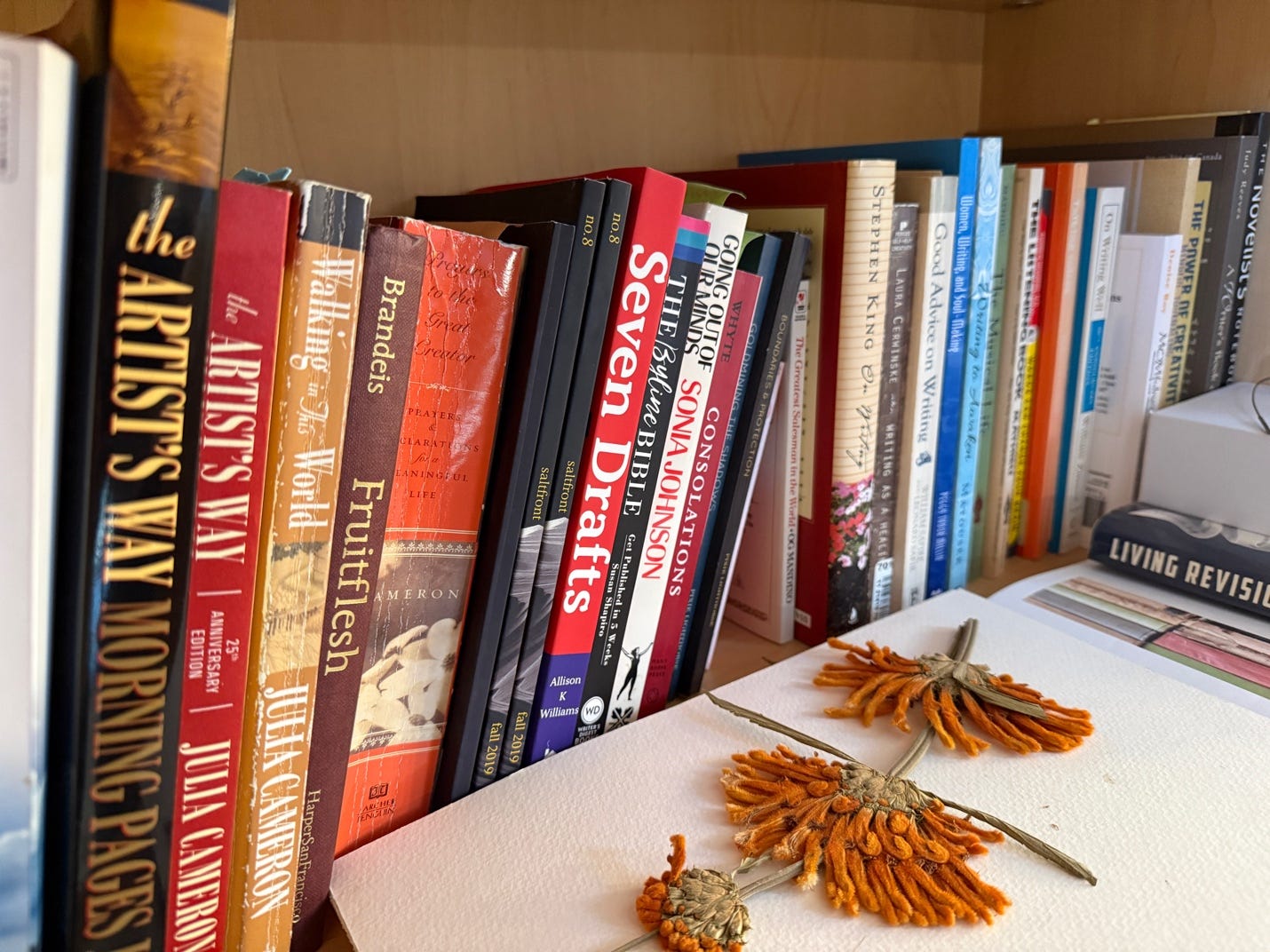
[Just of one my craft bookshelves; there are more]
But I came here to talk about morning voice memo recording, which I wish to compare with morning pages.
Writing by hand is getting more scarce in the culture at-large. My two daughters, a sophomore and a seventh-grader, are barely ever required to write by hand for school. I’ve provided them with notebooks for taking notes during class, fancy diaries, and date planners for goal-setting and time management… They started out strong utilizing them in September, but need to be goaded to write by hand. I noticed my seventh-grader’s cursive sucks, and she’s reluctant to write whole passages in cursive—despite my best efforts when she was in fourth grade. My sophomore’s cursive is passable. They’re home schooled, so I get all the credit and all the blame—even though I don’t stand there teaching them at a white board, the way people imagine, but curate a curriculum of virtual classes and help them with their homework like parents of schoolchildren do. I teach them home ec, fire safety, character development, civic duty, animal husbandry, phys ed, nutrition, sex and consent, and family values… the most important curricula.
I maintain a hand-written journal, and I take notes on every Zoom conference by hand. When I attend generative writing workshops, I write by hand. My best creative writing originates from hand-written practice and voice memos.
In 1997, I did a wilderness survival semester course in Costa Rica, Ecuador, and Peru. We were trekking, kayaking, mountaineering, and rappelling, sometimes five days’ walk from a hospital. Cell phones weren’t on the market yet. Our guides had a satellite phone in case of emergency. In 90 days, they never used it. I’d brought a microcassette recorder on that trip, and talked into it during one-, two-, and three-day-long wilderness solos where we were each led to a remote, isolated spot with only a sleeping bag, a tarp, a jug of water, some crackers, and a banana. The purpose was to fast and reflect and build a shelter to sleep in from whatever was available. An essay about my three-day wilderness solo was printed in Saltfront Magazine, Vol. 8. The essay sensually explored juniper berries, described how my skin changed, lamented a midnight episode of gastro distress, and concluded with me nearly getting trampled by a herd of sheep, and sharing an unforgettable eye gaze with an Incan shepherd wearing the trademark fedora.
I’ve digitized some of those microcassette recordings, but look at this trove that remains captive on cassette!
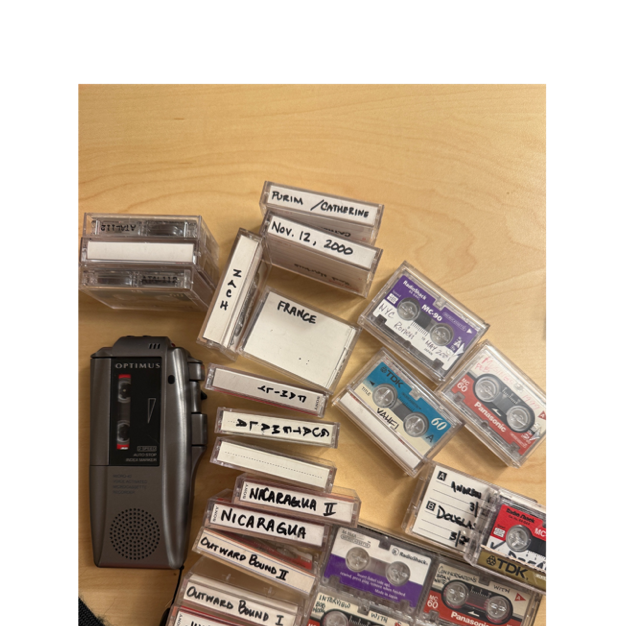
[Nostalgia hits when I play these recordings]
I read the essential book Talking Voices by Deborah Tannen during a linguistics course at NYU, and have been recording audio for thirty years. I recommend recording conversations and applying Tannen’s principle of the “speech-act” to your analysis. This and a book titled The Gentle Art of Verbal Self-Defense by Suzette Haden Elgin were pivotal in my understanding of dialogue. It’s a favorite topic of mine to teach. I offered advice to writers on how to write natural dialogue in Hippocampus Magazine here.
With varying consistency over the years, I’ve voice recorded my dreams in the morning. All too often, I think “That was so vivid! I’ll definitely remember it.” Inevitably, the dream gets lost forever. With my accountability partner, I set the goal of being more disciplined about recording my dreams—for personal fulfillment, creative writing inspo, and self-reflection. The exercise in analyzing symbolism, archetypes, and emotions is both an academic endeavor and a healing practice. (For dream analysis, I refer to symbol dictionaries like The Penguin Dictionary of Symbols, which contains more than a thousand pages of cross-cultural history and anthropology; or The Herder Dictionary of Symbols, a more concise book; or Symbols: A Handbook for Seeing, with sumptuous visual art analyses.)
I believe every day leaves its mark on me in some way. If I record it, then I have some assurance that it’ll never be forgotten, even when my memory fails. At Julia’s workshop, I raised my hand during the Q&A and asked, “Julia, I have a hard time waking up in the morning. Do you have some advice?” She answered, “Well, I can’t come wake you up,” and the room of 200 people broke out into laughter while I blushed. “…But, you’re here, aren’t you?” I did morning pages for three months straight after that. Would she approve of me choosing to record voice memos in the morning instead? Regardless, it is providing catharsis, and preserving some glimmers for later development into essays. Ten out of ten, highly recommend.